

Train phase — using observed signal
You have a corpus of marked sessions. Now use them to make the agent better.
Two paths
Section titled “Two paths”Path 1: Prompt iteration (cheap, fast)
Section titled “Path 1: Prompt iteration (cheap, fast)”The 90% case. You’re updating:
- SOUL.md — the persona. Tone, scope, escalation rules.
- Skills — what the agent knows how to do. Add new ones, update triggers / content / examples.
- Knowledge bases — what the agent knows. Add new sources, fix incorrect ones.
- Tool allowlist / denylist — what the agent can do.
- MCP servers — which external systems are connected.
This is the fast loop. Edit, save, start a new session, verify. Total cycle time: minutes.
Path 2: Expert fine-tuning (expensive, slow)
Section titled “Path 2: Expert fine-tuning (expensive, slow)”The 10% case. You’re training a task-specialised model on successful trajectories and pointing the agent at it.
Use when:
- The same task happens often (>100 times/week)
- The base LLM gets it wrong often enough to be a problem
- You have ≥100 good examples in your session log
- You have a way to host a fine-tuned model (vLLM, Anthropic, OpenRouter, etc.)
See Skills & Experts for the full lifecycle.
The expert training pipeline
Section titled “The expert training pipeline”Six steps, three of them outside the platform:
1. Define     (inside the platform)   SKILL.md with type: expert, status: draft
2. Collect    (platform → file)   POST /v1/skills/{name}/collect   → JSONL of successful trajectories
3. Train      (your fine-tuning pipeline)   Use OpenAI fine-tuning, Unsloth, Axolotl, etc.
4. Activate   (platform)   POST /v1/skills/{name}/activate with endpoint URL   → status: active
5. Monitor    (platform)   GET /v1/skills/{name} for expert_stats   → POST /v1/skills/{id}/retire when the success rate stops justifying it
6. Retrain    (collect → train → activate cycle)
The collect step produces an OpenAI fine-tuning JSONL with the platform’s prompt-template structure. Compatible with most fine-tuning APIs.
Filter on tainted sessions: by default, sessions with policy.denied, harness.crash, saga.compensated, or expert.override are excluded — they don’t contaminate the training set.
Datasets
Section titled “Datasets”The platform’s Datasets page sits between observation and training. A dataset is a versioned (Hub) corpus you can:
- Build from session conversations
- Upload as a CSV / JSONL
- Generate synthetically (teacher / judge / worker pattern)
- Build from prior expert training trajectories
Each dataset has four tabs:
- OVERVIEW — counts, status
- SAMPLES — preview rows
- PIPELINE — DAG of how this dataset was built
- REPOSITORY — the underlying Hub repo, with branches, commits, and tags
For details on each source type, see Datasets.
Training runs
Section titled “Training runs”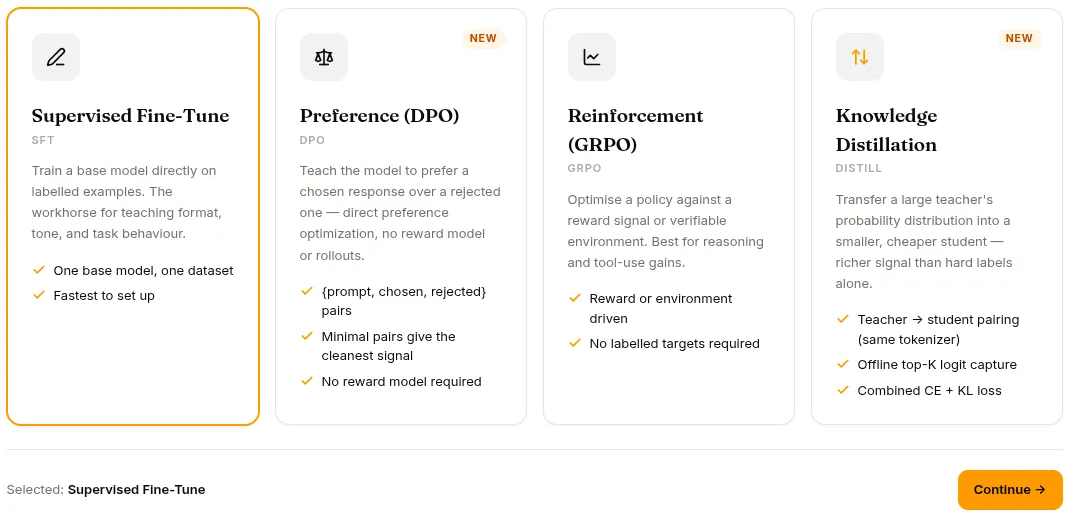
The Training page handles fine-tuning runs. Two methods:
| Method | What it is | When |
|---|---|---|
| SFT (Supervised Fine-Tuning) | Standard fine-tune from labeled trajectories | Most cases — you have good/bad examples |
| GRPO (Group Relative Policy Optimisation) | Reinforcement learning from rewards | When you have a clear reward signal — math problems, code that compiles, …) |
GRPO has an additional RL Mode picker:
- Environment — deterministic reward functions (math correctness, code compilation)
- Agent — model-judged reward
- RULER — runtime rule-based reward
See Training for the full configuration.
Evaluations
Section titled “Evaluations”After you’ve trained: run an evaluation to confirm improvement.
The platform ships 40 built-in benchmarks across 9 categories (reasoning, language, knowledge, coding, safety, chat, instruction, agent, vision). Plus a Custom Benchmark builder for scoring one of your own datasets.
Each evaluation produces:
- Per-benchmark score for the candidate model
- Comparison to a baseline (the previous version, the base LLM)
- Per-sample drill-down for the failures
- A versioned report you can share
A common pattern: gate every new expert deployment on a side-by-side eval. Don’t activate unless the new version beats the old by N%.
What’s next
Section titled “What’s next”Redeploy phase — rolling out the changes.